
Dish with floral decoration: Qajar Iran and Social Reimagining
By Regatu Asefa, 2025 Gardiner Museum Curatorial Resident
The Gardiner Museum Curatorial Residency is made possible through the generous support of the Rebanks Family.
My curatorial residency has allowed me to research and curate a passion project: an exhibition that explores social experiences of scent in historical and contemporary Islamic ceramics. [1] As I began my research, I was immediately drawn to the only historical Persian object in the Gardiner’s collection: a late-1800s Qajar-era dish. Being unfamiliar with Qajar Iran, I was curious about Dish with floral decoration. Why and how was this dish created? Where does it sit in the long history of Iranian productions? How might it have been used? The small bright dish allows for a reimagining and reconstruction of the past; I therefore aim to contextualize the floral dish within its historical social sphere and reframe it through scent in my contemporary retelling. Through this dish, we can delve into dining practices in Iran in the 1800s and evoke some of the sensory delights past peoples might have enjoyed.
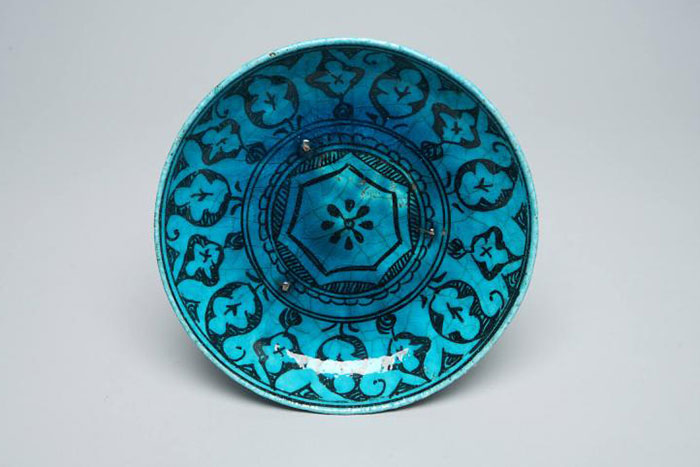
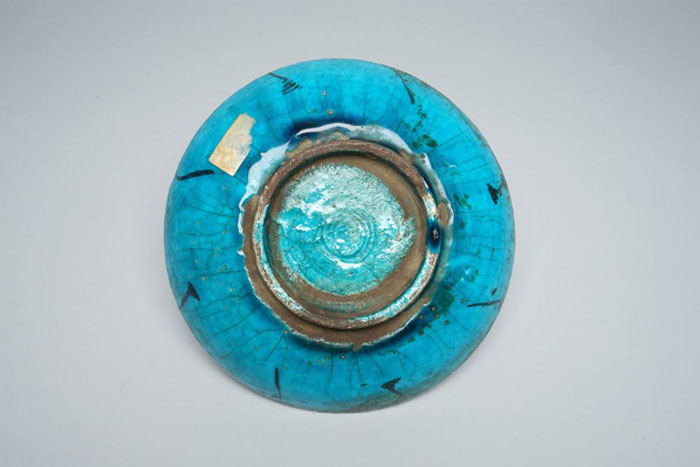
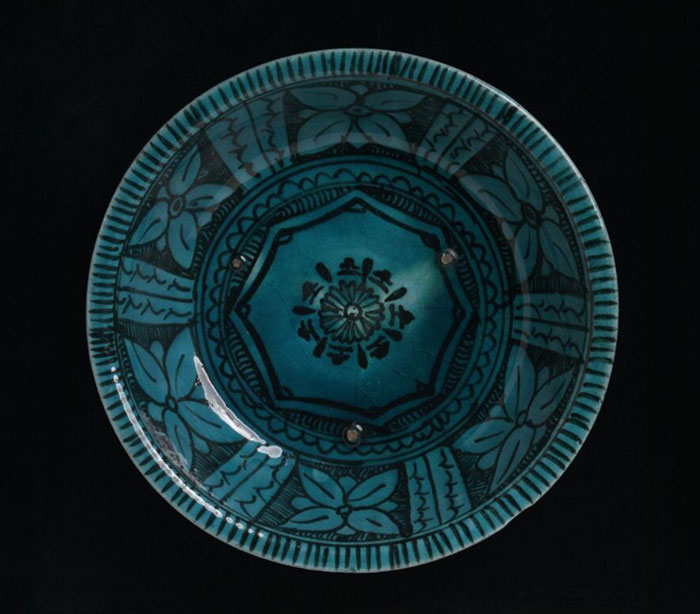
Dish with floral decoration, Iran, Qajar period (1779-1924), late 19th C, Stonepaste with black decoration under a transparent turquoise-blue glaze. Gardiner Museum, Gift of the Savard and Tabak Families, G22.8.2
After the fall of the Safavid Empire (1501-1722) in 1722 and decades of ensuing instability and warfare, Aqa Muhammad Khan Qajar (r. 1785-97) unified Iran and founded the Qajar dynasty (1785-1925). [2] The Qajar era marked a transitional period. Straddling across the nineteenth century, Qajar Iran legitimized itself through traditional connections to Safavid and medieval Iran while simultaneously embracing modernity and westernization of the period. Under Khan’s great-great-great nephew, Nasir al-Din Shah (r. 1848-96), Iran saw secured borders, relative peace, and the establishment of many of the social institutions that encouraged the arts to flourish, such as increased contact with European markets and more standardized financial, transportation, and telecommunication industries. [3] It is during this period that the Gardiner’s dish was created.
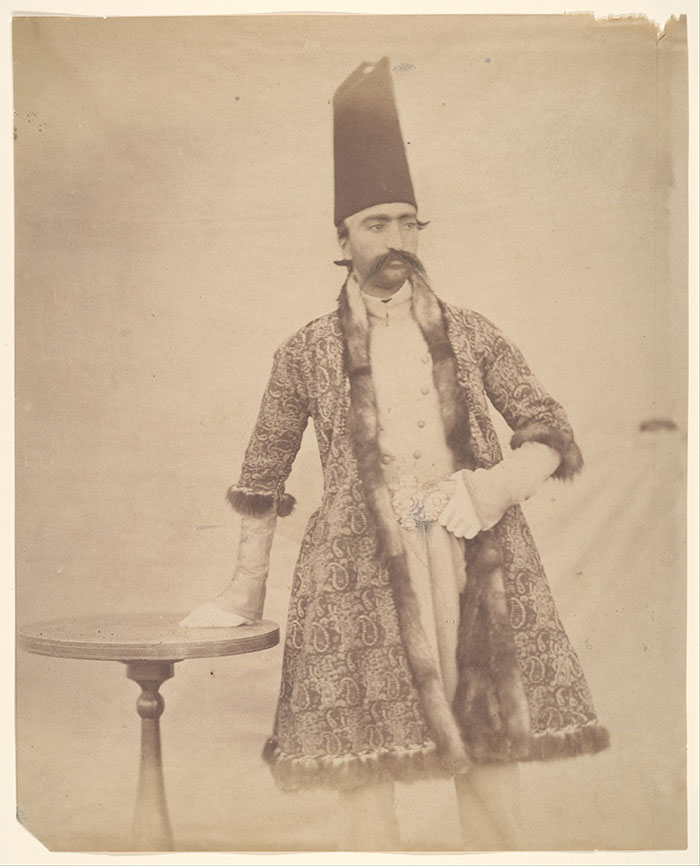
Naser al-Din Shah, possibly Luigi Pesce, 1840-60s, salted paper print. 1977.683.23. The Metropolitan Museum of Art
The late-1800s dish is made of stonepaste, or fritware, a medium developed in what is now Egypt at the end of the eleventh century and brought to Iran shortly thereafter. [4] Stonepaste is made up of quartz, glass frit, and fine white clay, and is thought to have been invented to imitate Chinese porcelain. [5] The dish’s deep turquoise glaze is a hallmark of Persian ceramics first introduced in the eleventh century. The black underglaze technique employed for the floral and vegetal design was developed in Iran around 1200. [6] The centre features an abstracted flower within a double-walled heptagon that is itself within a hatched circle and bubbled border. Two stylized leaves form a pattern around the outside band. Similar standardized motifs appear on other Qajar-period ceramics and are no doubt in part inspired by earlier Safavid examples.
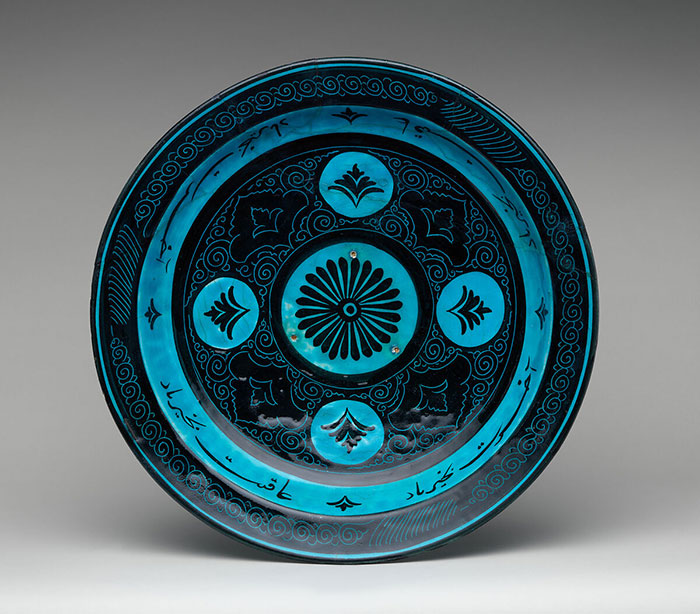
Dish, Iran, probably Tabriz, second half of the 15th century, Stonepaste; painted in black under a turquoise glaze, incised (Kubachi ware). 17.120.72. The Metropolitan Museum of Art
Dish, Iran, 19th century, fritware painted under the glaze. 1129-1905. © Victoria and Albert Museum, London
The similarities only reinforce the Qajar period’s ode to earlier Iranian production and the dynasty’s attempts to tie itself to past Persian powers, with the motifs, medium, glazes, and colours drawn from earlier periods. Yet, the standardization of motifs in functional ceramic wares alludes to nineteenth-century mass production for both domestic and foreign markets, especially in the major production centres including Tehran, Shiraz, Isfahan, and Nain. [7] As European interest in Persian ceramics grew in the nineteenth century, artists continued to revive traditional methods, creating a distinct cultural identity through Qajar exported goods in an increasingly globalized world. [8]
But what might the dish have been used for? In Qajar Iran, there was no designated eating room in most homes, with the ivan (a sort of living room space) often acting as a hallway, a dining room, bedroom, and living room as the need arose. [9] Because of this, many Persian homes were limited in their furnishings. There were, however, lots of carpets and runners along the walls, blind arches with objects including glass jars, candelabra, fine china, and fruit dishes that were used for entertaining. [10] When the ivan was used for dining, people would sit around a cloth (sufra) laid out on the floor and upon which food was served. [11] The Qajar diet consisted of grains such as rice and wheat, vegetables, soups, meat stews known as abgust, yogurt, cheese, fruit, and bread, the latter acting as cutlery at every meal. Tea flowed between and during meals. After eating, a qalyan (hookah) was brought out and shared by the guests present. [12] In light of Qajar dining habits, we can imagine how an object such as the Gardiner’s Persian dish could have been brought out from its niche to be filled with sweet fruits or pungent cheeses during a lively meal.
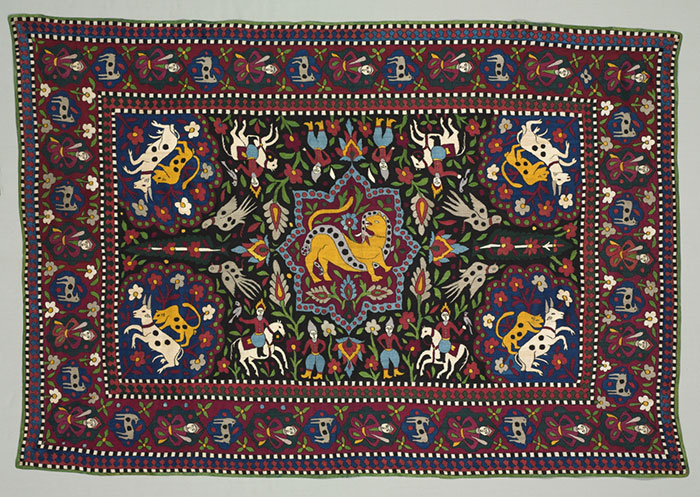
Ceremonial or summer floor cover, Iran, Qajar period, 1800s, cotton: plain weave; silk; embroidery. Gift of Mr. and Mrs. J. H. Wade. 1916.1313. The Cleveland Museum of Art
Dish with floral decoration came to the Gardiner in 2022 as a donation from Diana Tabak and John L. Savard. They inherited the dish from their mother, who had inherited it in 1950 from the estate of Harry Norton, a long-time art collector. When Norton died, his collection was broken up; some objects went to the Royal Ontario Museum (ROM) and the Montreal Museum of Fine Arts (MMFA) while others were sold to dealers and collectors. [13]
The dish will be on view in Pleasant Smells and Warm Fellowships: Scent in Islamic Ceramics from January 16, 2026 to April 5, 2026. The exhibition explores scent in gendered social settings as expressed through ceramics including tableware, incense burners, and water-pipes. The objects exhibited reveal an interconnected and fragrant social sphere through the Islamic world. The Gardiner’s Persian dish is reframed through the social, sensory, and emotional histories to which it undoubtedly contributed, placing nineteenth-century Qajar life in twenty-first century downtown Toronto.
Notes:
[1] The term ‘Islamic’ in art history has stirred scholarly inquiry. See, for example, Gülru Necipoglu, “The Concept of Islamic Art: Inherited Discourses and New Approaches*,” Journal of Art Historiography, 6 (2012); Avinoam Shalem, “What do we mean when we say ‘Islamic art’? A plea for a critical rewriting of the history of the arts of Islam,” Journal of Art Historiography, 6 (2012); Sheila S. Blair and Jonathan M. Bloom, “The Mirage of Islamic Art: Reflections on the Study of an Unwieldly Field,” Art Bulletin 85, 1 (2002):152-84; Onur Öztürk, Xenia Gazi, and Sam Bowker, Deconstructing the Myths of Islamic Art (New York/London: Routledge, 2022).
[2] Abbas Amanat, “Qajar Iran: A Historical Overview,” in Royal Persian Paintings: The Qajar Epoch 1785 – 1925, eds. Layla S. Diba and Maryam Ekhtiar (New York: Brooklyn Museum of Art in association with I. B. Tauris Publishers, 2000), 16.
[3] Maryam Ekhtiar and Marika Sardar, “Nineteenth-Century Iran: Continuity and Revivalism,” in Heilbrunn Timeline of Art History (New York: The Metropolitan Museum of Art, 2000–, October 2004). https://www.metmuseum.org/essays/nineteenth-century-iran-continuity-and-revivalism. See also Amanat, “Qajar Iran: A Historical Overview.” For a family tree of the Qajar royal family, see figures 1 a and b in ibid,16-17.
[4] See “Iranian Fritware: 12th-13th Century” in Oliver Watson, Ceramics From Islamic Lands (London: Thames & Hudson, 2006), 303-26.
[5] James W. Allen, Islamic Ceramics (Oxford: Ashmolean Museum, 1991), 16.
[6] Ibid., 18, 22.
[7] For more on the economy and trade of Qajar Iran, see for example C. Issawi, ed., The Economic History of Iran 1800-1914 (Chicago: University of Chicago Press, 1971); Hassan Hakimian, “Economy viii. In the Qajar Period,” Encyclopaedia Iranica VIII, 2 (2014):138-43; Gad G. Gilbar, “Qajar Dynasty viii. ‘Big Merchants’ in the Late Qajar Period,” Encyclopaedia Iranica, online edition (2019). For ceramic production in Qajar Iran, see J. M. Scarce, “Art in Iran x.1 Art and Architecture of the Qajar Period.” Encyclopeadia Iranica, September 28, 2016. https://www.iranicaonline.org/articles/art-in-iran-v-qajar-1-general/.
[8] See Ekhtiar and Sardar, “Nineteenth-Century Iran: Continuity and Revivalism,” and Jillian Echlin, “Finding (and Teaching) the Ceramics of Iran in a Contemporary Context,” Studio Potter 43, 2 (2018):31.
[9] Hosna Varmaghani, “The Impact of the Middle Class Houses of the Qajar Era (Case Study: Northern Cities of Iran,” Space Ontology International Journal 7, 1 (2018): 61.
[10] Shireen Mahdavi, “Everyday Life in Late Qajar Iran,” Iranian Studies 45, 3 (2012):360.
[11] For more on Qajar dining habits and examples of typical meals, see Mahdavi, “Everyday Life in Late Qajar Iran,” 355-70, especially 364. See also Shireen Mahdavi, “Qajar Dynasty xiv. Qajar Cuisine.” Encyclopædia Iranica, online edition, 2015. http://www.iranicaonline.org/articles/qajar-14-cuisine.
[12] Mahdavi, “Everyday Life in Late Qajar Iran,” 363-64.
[13] “Virtual Exhibit: The Norton Collection of Ancient Glass,” Musée Beauline au Châterau Norton, https://www.museebeaulne.qc.ca/en/virtual-exhibit-ancient-glass/.