
The Rosalie Wise Sharp Collection of Blue and White
By Dr. Karine Tsoumis, Senior Curator
The Gardiner Museum presents a new, monumental installation: a floor-to-ceiling display of over 500 blue-and-white ceramics rhythmically arranged by shape, hue, and decoration. Assembled over decades and generously donated by Toronto collector Rosalie Wise Sharp, this extraordinary collection reflects a lifetime of passionate engagement with the medium of clay and its varied histories.
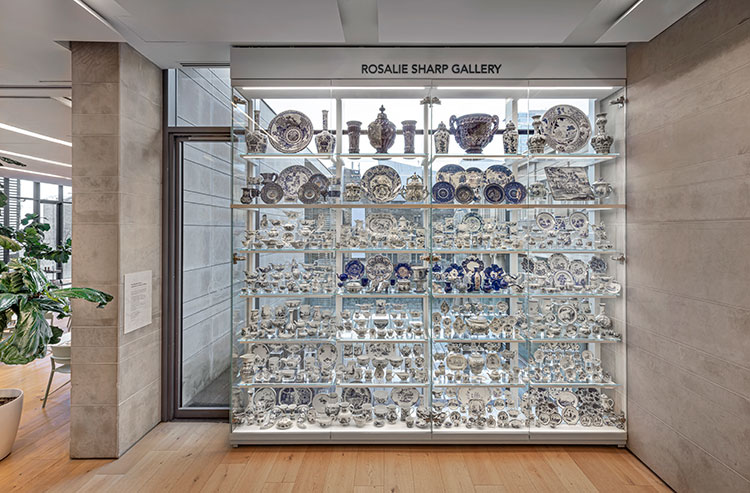
Rosalie Sharp Gallery. Photo: Toni Hafkenscheid
Centuries of Blue and White
Like many great collectors before her, Rosalie Wise Sharp was drawn to the seductive power of a colour palette that transformed ceramic production and rose to global fame: blue and white. Cultural and economic forces shaped the trend for ceramics decorated in blue and white over centuries. Potters in Jingdezhen, China were the first to perfect porcelain decorated in underglaze blue during the Yuan dynasty (1271–1368). From this time onward, blue-and-white porcelain circulated widely along land and sea routes. While Chinese ceramics had a long history of consumption in the Middle East, they remained rare in Europe until the late 1500s.
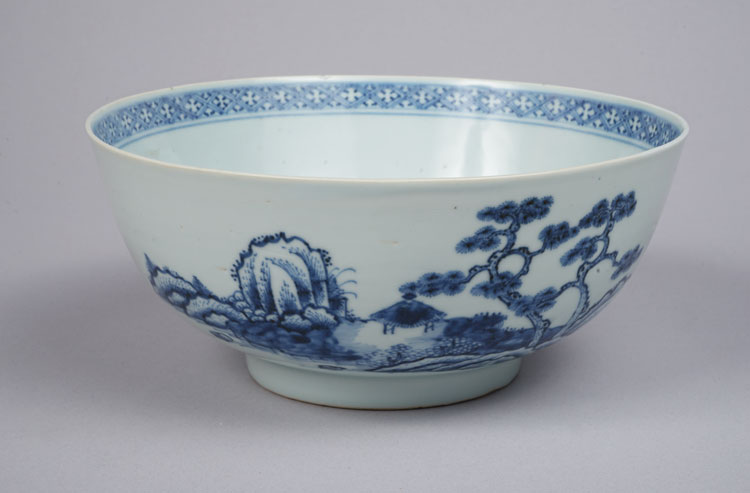
Figure 1 Bowl recovered from a shipwreck (the Geldermalsen), Jingdezhen, China, ca. 1752, porcelain. The Rosalie Wise Sharp Collection of Blue and White
Beginning in the early 1600s, the Dutch East India Company brought millions of porcelain vessels to Europe. Maritime archaeology testifies to the scale of this trade, which continued into the following century. This bowl (Figure 1) is one of over 150,000 pieces of porcelain recovered from the wreckage of the Geldermalsen, an East India Company merchant ship that sank in the South China Sea in 1752. These objects are often referred to as the Nanking Cargo. Most of them were of the blue-and-white type and, like this bowl, were found in pristine condition after 250 years under the sea.
Everywhere it travelled, Chinese blue-and-white porcelain inspired artists to experiment with techniques and decorative styles, giving rise to a wealth of local traditions. Objects from the Rosalie Wise Sharp Collection of Blue and White reveal how in the 1500s and 1600s, potters active in Italy, France, the Netherlands, and England applied a tin-glaze over an earthenware body to create a white surface for decoration in cobalt. With this technique—called maiolica, faience, or delftware depending on place of production—artists imitated Chinese porcelain in appearance only.
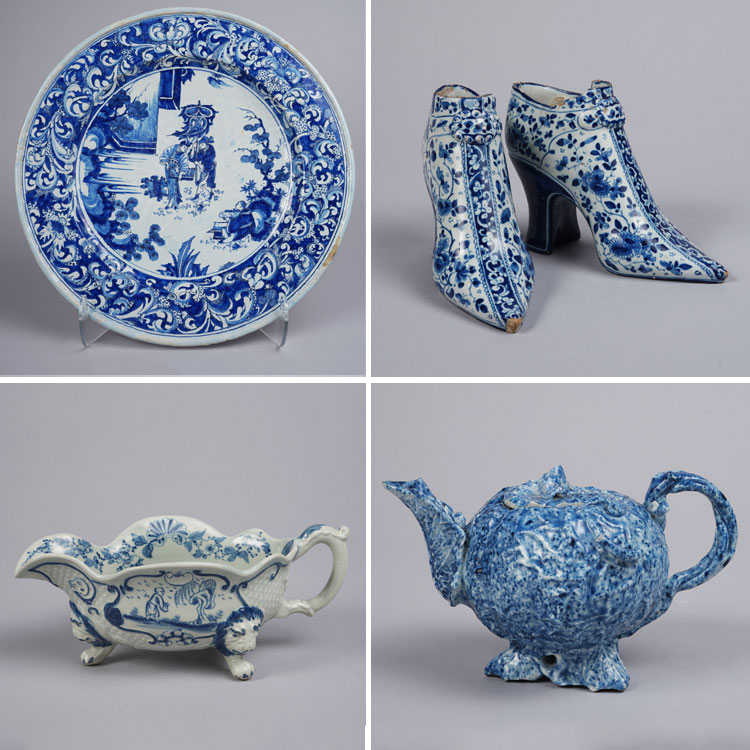
Figure 2 A selection of objects from the Rosalie Wise Sharp Collection of Blue and White. Clockwise from top left: Charger with chinoiserie, Nevers, France, late 17th century, tin-glazed earthenware (faience); Pair of shoes, London or Bristol, England, 1727, tin-glazed earthenware (delftware); Melon-shaped teapot, Longton Hall Porcelain Factory, England, ca. 1755–65, soft-paste porcelain; Sauceboat with chinoiserie, Limehouse Porcelain Factory, England, ca. 1746–48, soft-paste porcelain
Demand for porcelain would inspire a style known as chinoiserie. Often featuring figures in fanciful gardens, chinoiserie, which originally drew from imported goods, projected fantasies of the Far East, leading to racial stereotypes. The style continued to flourish throughout the 1700s, as Europeans succeeded in making a porcelain paste that shared the physical properties of Chinese porcelain (see the examples from Nevers and Limehouse in Figure 2). In England, the 1740s and following decades were a critical time of experimentation and innovation. Independent entrepreneurs established porcelain manufactories around London, each developing their own recipe. The English porcelain body is known as “soft-paste” and did not include kaolin, a key ingredient used in Chinese porcelain. Emerging factories such as Bow, Worcester, or Limehouse sought to compete with imported products while creating objects that responded to the needs of contemporary life. With a great majority of objects made in England, the Sharp Collection documents this exciting moment through the lens of blue and white.
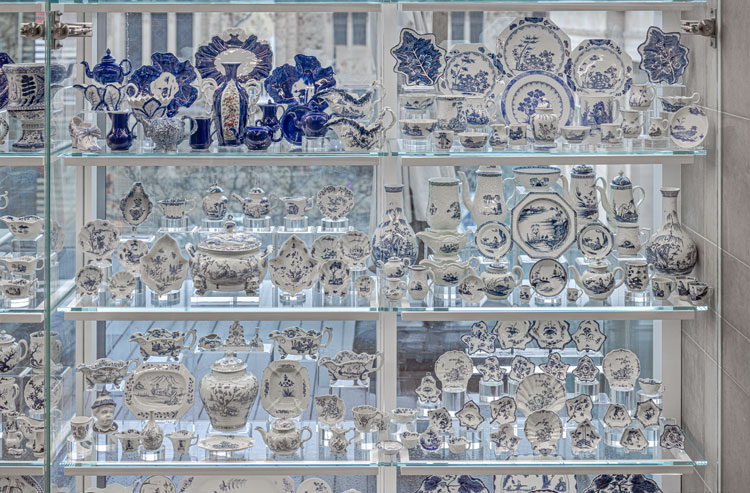
Rosalie Sharp Gallery (detail). Photo: Toni Hafkenscheid
Viewed as an ensemble, the Collection communicates overarching narratives about trade and collecting, global and local fashions, and technical innovation. Within this mesmerizing display, individual pieces, however, tell their own complex histories. For Rosalie Wise Sharp, the “intimacy of ceramics” and the stories they tell about the people who once owned them, or made them, is key: “what were their lives, their work, their beliefs?”[1]
A close look at an Italian ewer, a Dutch milk pan, and an English punch bowl made decades apart reveal how multiple narratives intersect into small objects.
Questions of Value
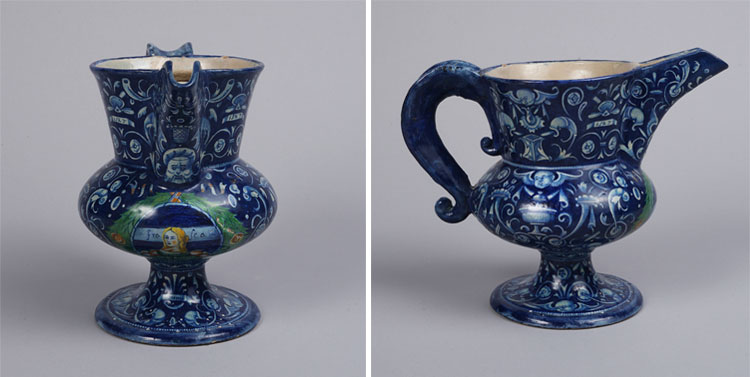
Figure 3 Ewer with female portrait, Faenza, Italy, 1527, tin-glazed earthenware (maiolica). The Rosalie Wise Sharp Collection of Blue and White
In the first half of the sixteenth century, Chinese ceramics were still rare in Italian homes and their ownership was typically limited to elite members of society. While examples predominantly featured cobalt blue decoration on a white ground, Italian inventories also record Chinese vessels fully covered in a dark cobalt glaze—albeit in much smaller numbers. Maiolica potters in the town of Faenza captured these ceramic influences, blending them with European decorative elements as exemplified by this superb ewer (Figure 3). The piece shows delicate motifs of masks and fantastical figures in metamorphosis (known as grotesques) against a rich blue ground. This ewer would have been costly, for both its refined workmanship and its generous use of cobalt, a mineral obtained through long-distance trade. Yet, it is important to remember that maiolica stood on the lower end of the luxury scale at the time. As ceramic vessels were less expensive than tableware made of precious metal, their ownership could extend from rich merchants to prosperous artisans.
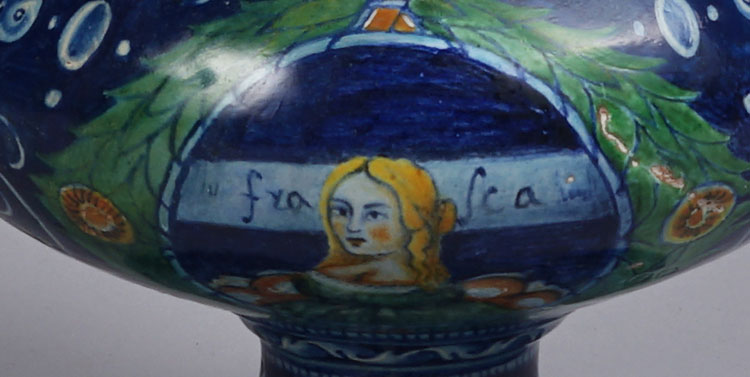
Ewer with female portrait (detail), Faenza, Italy, 1527, tin-glazed earthenware (maiolica). The Rosalie Wise Sharp Collection of Blue and White
The piece’s social value is further underscored by the date, 1527, and by the idealized image of a young, blond-haired woman. An inscription identifies her as Francesca (shortened to “Fra.sca”). While nothing is known about Francesca, the object type and the presence of a date signal that the ewer was likely made to mark a pivotal moment in her life. In the 1500s, female portraits accompanied by names or other inscriptions commonly appeared on objects offered as gifts to mark significant events, particularly betrothal and marriage. Contemporary sources even suggest that ewer and basin sets were considered appropriate gifts for young women of marriageable age. Filled with rose-scented water, they would have been used for ritual handwashing after a meal on important occasions such as wedding banquets.
As Francesca was probably the object’s original owner, we are compelled to consider her experience at a transitional moment of her life: did the ewer inspire joy, anticipation, or apprehension as she held it in her hands?
A Royal Milk Pan
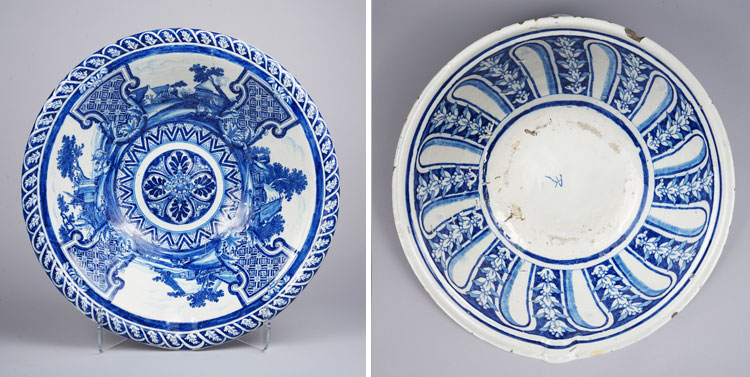
Figure 4 Milk pan, Greek A Factory, Delft, The Netherlands, ca. 1690, tin-glazed earthenware (delftware). The Rosalie Wise Sharp Collection of Blue and White. The back of the piece features a mark for Adrianus Kocx (active 1689–1694), the factory’s proprietor. A spout, necessary to drain the milk from the pan, can be seen on the rim.
By contrast to the anonymity of the ewer’s first owner, this milk pan speaks volumes about its patron: Mary II, Queen of England (1662–1694), leading ceramic collector and tastemaker of the late 17th century. The milk pan is one of six surviving examples which Mary II commissioned from the Greek A Factory in Delft around 1690 for use in her dairy at Hampton Court (Figure 4). The piece invites us to discover aspects of Queen Mary’s life, from her passion for ceramics and their grand display, to the symbolic role of dairies.
Mary was only 15 when she moved to the Netherlands to wed William of Orange (1650–1702) in 1677. While living in the Netherlands, she developed a profound love for ceramics and their use as decorative elements on a grand scale. Such arrangements are known as “porcelain rooms.” In 1688, Mary and William ascended to the throne of England as joint rulers. Upon returning to London, the Queen introduced this form of ceramic display to her new surroundings. At Kensington Palace, she displayed nearly 350 pieces of Chinese and Japanese porcelain, above cabinets, chimney pieces, and pedestals in symmetrical groupings. The fashion for porcelain rooms spread across England under her influence, while also raising criticism for its excess. While these spaces do not survive, engravings by Daniel Marot (1661–1752), the architect and designer who shaped Mary’s decorative world, give us a sense of these arrangements (Figure 5).
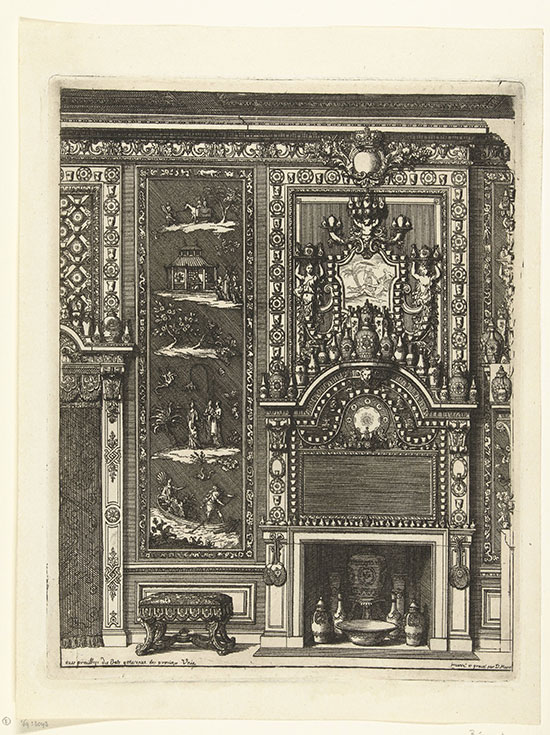
Figure 5 Daniel Marot (1661–1752), Design for a chimney wall, 1673-before 1703. Rijksmuseum, Amsterdam
Queen Mary was a great supporter of European ceramic manufacture and tin-glazed earthenware made at Delft (delftware) was equally present in her elaborate decorative schemes. In her recreational dairy at Hampton Court (located in the Water Gallery), she chose to display blue-and-white delftware en masse. This would have been the original home of the milk pan from the Sharp Collection.
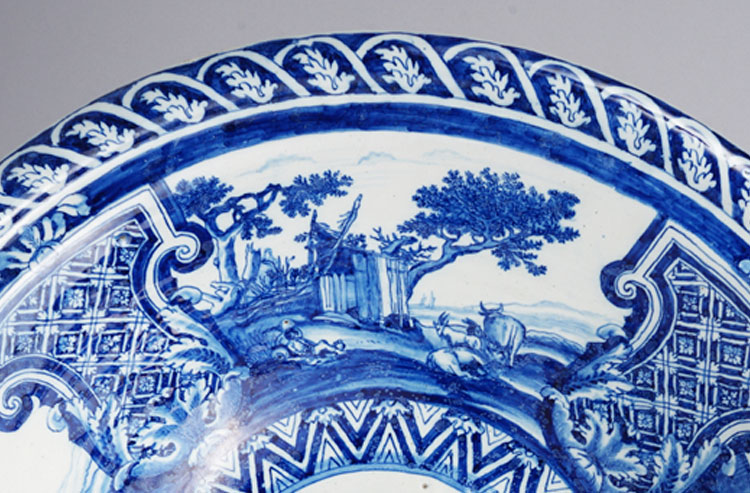
Milk pan (detail), Greek A Factory, Delft, The Netherlands, ca. 1690, tin-glazed earthenware (delftware). The Rosalie Wise Sharp Collection of Blue and White
Featuring bucolic landscapes with farmhouses and cattle framed by ornamental panels, this object evokes the Arcadia constructed by elite women in pleasure dairies. Such spaces had been cultivated by female rulers since the Renaissance as symbolic expressions of power and fecundity. While the work of the dairy—the production of cream, butter, cheese and more—was performed by dairymaids, Mary II and her guests would have presented themselves as embodiments of domestic ideals in a space created as a refuge from courtly life.
It is tempting to think that Mary II once held this object, and perhaps even used it to drain out the milk, pouring it from the pan’s spout once the cream had separated.
Production Challenges
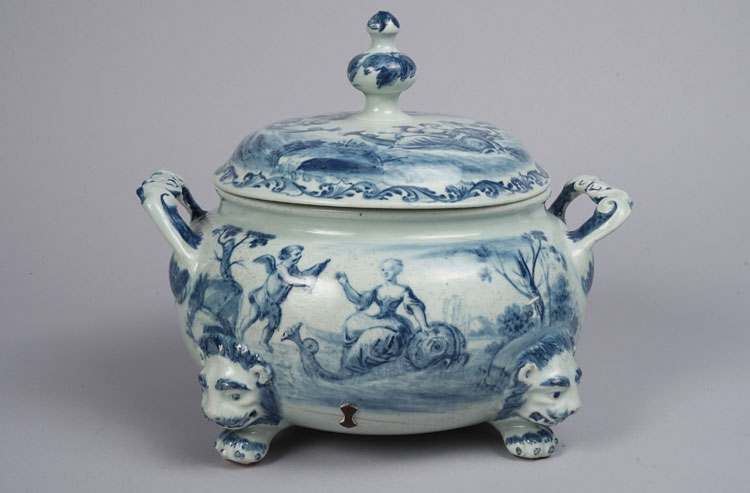
Figure 6 Covered tureen or punchbowl, Limehouse Porcelain Factory, ca. 1746–48. The Rosalie Wise Sharp Collection of Blue and White
Making porcelain in 1740s England was a challenging and risky business. This was a phase of experimentation, when ceramic entrepreneurs were working towards the development of recipes for a porcelain paste that could both be modelled in the latest styles and robust enough to be usable for serving hot beverages without cracking. Firing incidents were common. While flawed objects could be discarded, others were kept and cherished, including this covered tureen (Figure 6). Perhaps used as a punchbowl or to serve mulled wine, it was made at the Limehouse Porcelain Factory in East London. Established in 1745, Limehouse was one of England’s earliest porcelain ventures.
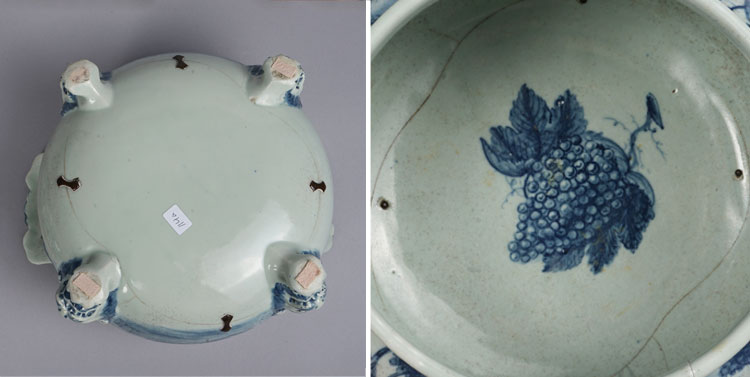
Covered tureen or punchbowl (detail), Limehouse Porcelain Factory, ca. 1746–48. The Rosalie Wise Sharp Collection of Blue and White
The object’s underside and interior reveal a network of cracks and silver rivets that are likely contemporary to the piece. The rivets were probably used to hold the vessel together, securing fractures that extend from an original firing crack. It is also possible that the bowl cracked when it was used to contain a hot liquid, such as mulled wine. The piece was preserved for centuries despite this manufacturing defect. But why? The punch bowl would have been considered an accomplishment for the young factory, being considerably larger than most works it produced. It was also a feat of modelling—its scroll handles and lion’s-head feet lending complexity to the form—while its refined decoration demonstrates knowledge of the latest fashions. The highly imaginative seascape with putti and maidens riding dolphins was inspired by engravings after work by Francois Boucher (1703–1770), the leading French Rococo painter of the time.
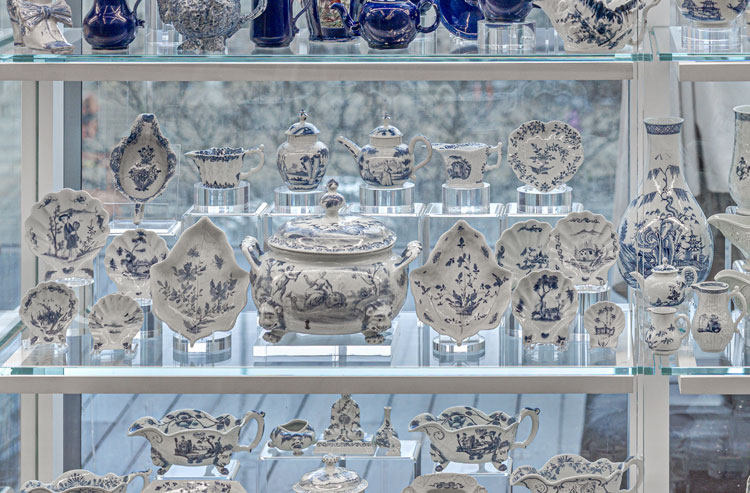
Detail from the Sharp Gallery featuring the punchbowl and other pieces made at Limehouse. Photo: Toni Hafkenscheid
Beauty is often found in imperfections. Rosalie Wise Sharp writes: “It is rare, by the way, that I fix up cracks, which I prefer to see uncovered. […] I prefer an early piece in poor condition over the opposite. After all, I myself might have a few flaws after 270 years.”[2] The punchbowl’s imperfections are rich in significance. They speak to challenges faced by ceramic workers while simultaneously highlighting the technical achievements of an enterprise famous for its brief existence. The factory closed its doors in 1748 after a mere three years of activity. In the absence of documentary evidence, it’s been surmised that this was due to its struggles with technical problems and a lack of financial resources. Exploration, experimentation, risk, and adventure remain at the heart of making ceramics.
The Rosalie Wise Sharp Collection of Blue and White is now on permanent display at the Gardiner Museum.
Notes:
[1] Email interview with Rosalie Wise Sharp, October 23, 2025.
[2] Rosalie Wise Sharp, China to Light Up a House: Mainly Mid-Eighteenth Century English and French Porcelain, vol. 1 (Toronto: ECW Press, 2015), p. 174.
Resources:
Ayers, John, et al. Porcelain for Palaces: The Fashion for Japan in Europe, 1650-1750. Oriental Ceramic Society; British Museum: 1990.
Bayer, Andrea, et al. Art and Love in Renaissance Italy. New York: The Metropolitan Museum of Art, 2008.
“Geldermalsen.” MaSS. Stepping Stone of Maritime History. Accessed April 16, 2026. https://mass.cultureelerfgoed.nl/geldermalsen
Moon, Iris. Monstrous Beauty: A Feminist Revision of Chinoiserie. New York: The Metropolitan Museum of Art, 2025.
Tsoumis, Karine. Maiolica in Renaissance Venice: Ceramics and Luxury at the Crossroads. Munich: Hirmer Publishers, 2021.
Wheeler Brown, Genevieve. Beyond Blue and White: The Hidden History of Delftware and the Women behind the Iconic Ceramic. New York: Pegasus Books, 2026.
Wise Sharp, Rosalie. China to Light Up a House: Mainly Mid-Eighteenth century English and French Porcelain, vol. 1. Toronto: ECW Press, 2015.
Wise Sharp, Rosalie. China to Light Up a House: English Pottery & Later Porcelain, vol. 2. Toronto: ECW Press, 2015.